“I LOVE the journaling!!!! As a literacy specialist, it makes me so happy to see children so young learning to express themselves through pictures and words!!! Thank you, Miss Murphy for creating such an AMAZING learning environment for our babies!!!!!” Pam, M.Ed., Hogarth mom to Brady, Logan and Camden in a May 28, 2015 comment left on a Highlights post.
The pillars of Hogarth’s early literacy curriculum include the Agenda, storytime with pre- and post-reading discussions, and Tweeting. (In late 2022 we transitioned from Tweeting to Peeping. You’ll find more information on that here.) With the addition of journaling and reporting, our early literacy curriculum is unparalleled.
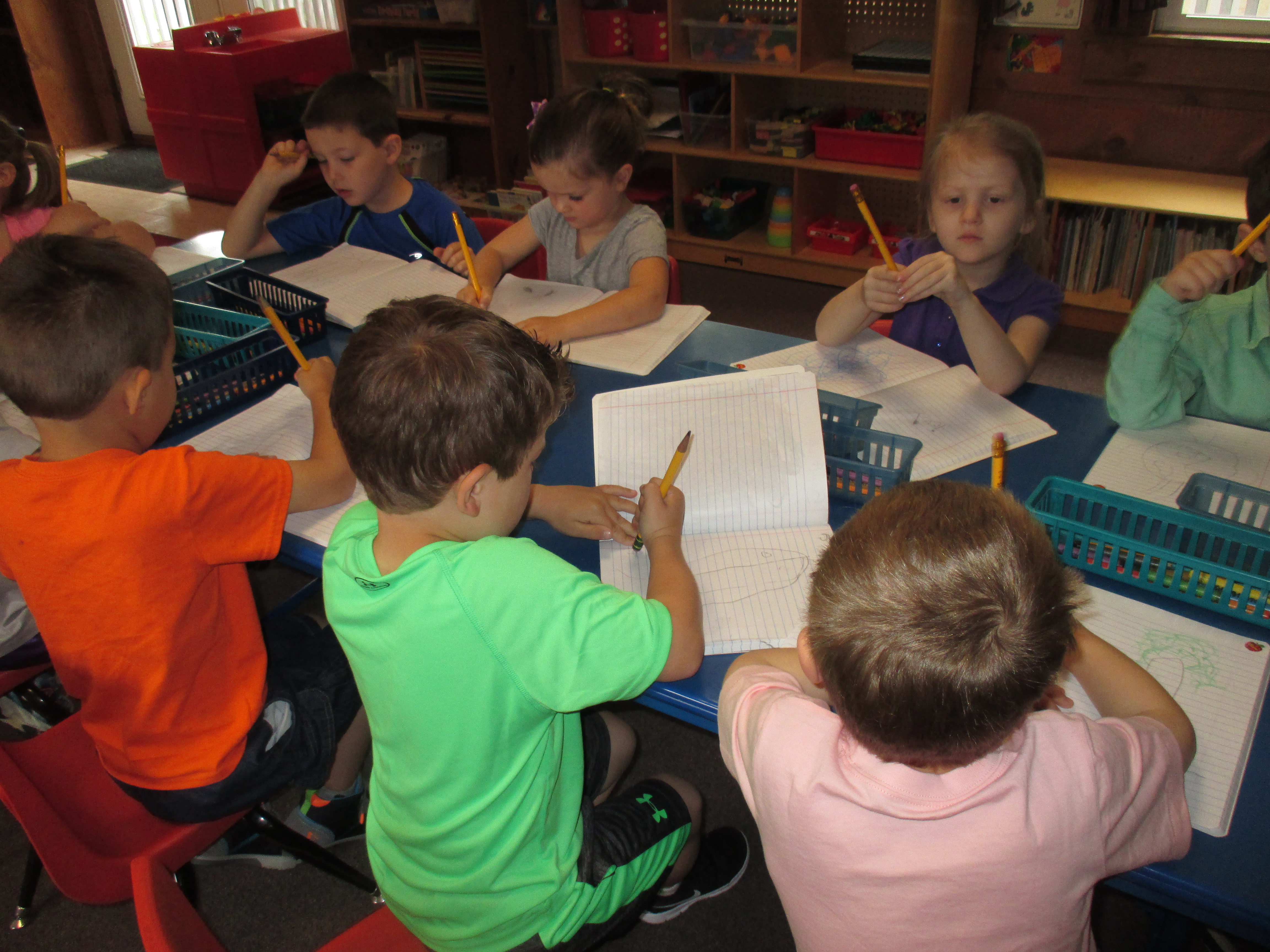
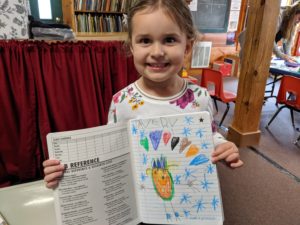
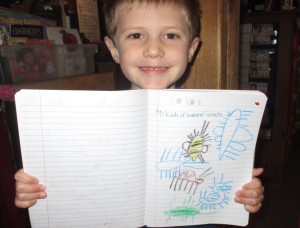
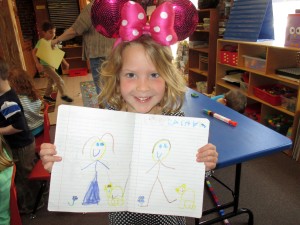
The children journal most weeks usually starting in late winter, when their growing skills and confidence make this work especially meaningful. Journals serve as a rich outlet for self-expression, while also supporting early literacy and numeracy development in a natural, integrated way.
As children draw, they are telling stories—about their experiences, their ideas, and their understanding of the world. Many choose to dictate text for me to record alongside their illustrations, helping them see the connection between spoken and written language. Over time, children begin to incorporate their own letters, sounds, and symbols, experimenting with writing in a way that is both personal and purposeful.
Each child’s next blank page is marked with a small sticker in the corner, helping them independently locate where to begin. This simple system supports organization, builds confidence, and reinforces a sense of ownership over their work.
During journaling time, I play a curated playlist of writing-related songs. The music provides a gentle structure: children work for the duration of the playlist, and when the music ends, they begin to wrap up. This “frame” helps children develop stamina, focus, and a sense of time, while still allowing flexibility. There are always a few who wish to continue—“But I’m not done!” is a familiar refrain—and they are always welcome to keep working.
Through journaling, children are building a wide range of foundational skills, including fine motor control, storytelling, symbolic thinking, early writing, and sustained attention. Just as importantly, they are developing a sense of themselves as capable communicators whose ideas are worth recording and sharing.
Journals are sent home when a child “graduates” from Hogarth, and many children will have worked in theirs over the course of two or even three years. These journals become treasured keepsakes, offering a window into each child’s growth and the remarkable progression of their thinking, drawing, and writing over time.
The children usually start filing reports in late September or early October. What are reports? They are accounts of activities your child participated in on a particular day which are collected from all the children and published weekly as The Highlights. They are dictated to me by your child. I read it back to the reporter who then edits for detail or clarification before they approve the final report. If your child held the flag for the Pledge of Allegiance, they will be the flag reporter. If they are the Mystery Kid, they will report on the Agenda. Children report on the books we read, songs we sing, art projects we do, playtime adventures, and all the other bits and pieces that make up a preschool day at Hogarth. A child typically reports once each week, but there will be days or weeks when our activities or unforseen time bandits will not allow everyone to report. If your child or child’s class doesn’t report one week, they probably will the next. The same goes for peeping, which sometimes falls prey to time bandits, as well.
How do I explain the concept of reporting to the children? I tell them they are my Hogarth reporters. I explain that reporters bring news to people. They tell people about events those people did not witness. Since they’re the only ones to go to Hogarth in their families, it’s up to them to report the Hogarth news for their families to read at home.
I explain the difference between Reporting and Peeping. Reporters report the facts of that one particular school day. Peepers write about anything their hearts desire.
Reporting impacts the children’s early literacy skills in a big way. Questions and prompts from me give direction and clarification to the reporting process. Going over the events of the day in their minds, pulling out those bits of information they feel are important, and then articulating their thoughts in such a way that the reader gets a full picture is going to sharpen their powers of observation and make them more mindful of the unfolding school day. Thinking over the day also gives the children an opportunity to review the material we covered. Listening to their responses lets me know if I presented the material clearly enough to be understood.
As a teacher, I love hearing the children retell the stories we read each day. It lets me see how much of a connection there is between the children and the stories. As a writer, I love hearing what the children take away from the stories. What “speaks” to them. I look to see what works in a story and what falls flat. I find inspiration for my writing in their reporting!
The children’s reports are written verbatim. I want each child to have his or her own authentic voice. I think you’ll find these Highlights reports great fun to read. Here are a few samples reports:
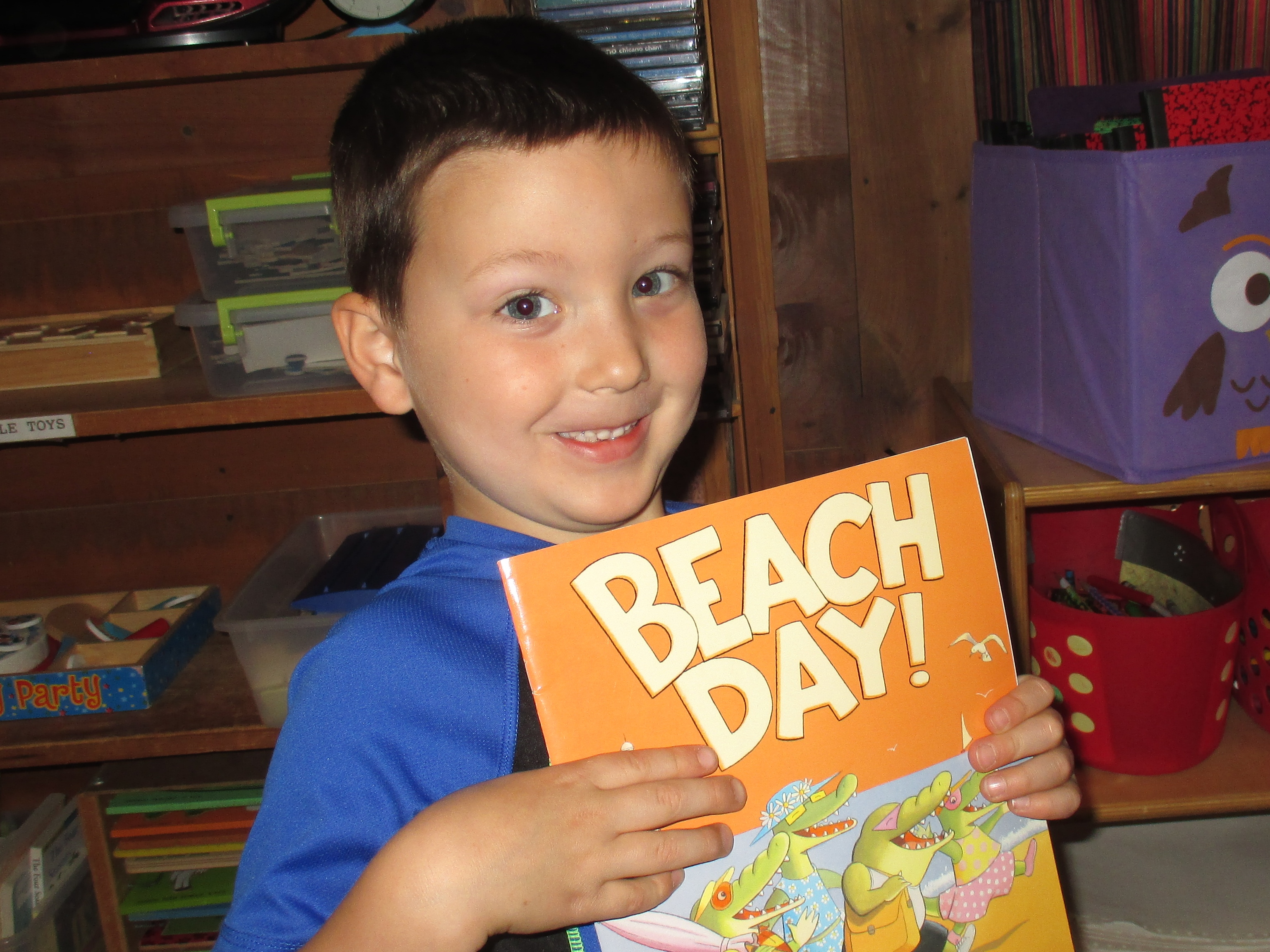
Logan: We read a soft cover book and it was called Beach Day! (Italicized print that follows is Logan reading directly from the book.) “Hot!” said Sam. “Sunny, ” said Pam. “Sweaty,” said Will. “Swim?” said Jill. “Beach!” said Sam, Pam, Will, and Jill. They decided to go to the beach and they were going to play because they saw a park. And they pedaled up and down and under and even through a mountain of clover. And then one said, “Picnic.” “Sandwich,” said Sam. “Pasta,” said Pam. “Pickles,” said Will. “Burp!” said Jill. They napped and then they slept past 1 and they slept past 2 and they slept past 3 and they slept past 4. “Let’s go!” said Sam. “But where?” said Pam. “Over there!” said Will. That hill?” said Jill. “Push!” said Sam, Pam, Will, and Jill. “Beach!” said Sam, Pam, Will, and Jill. They swam by the light of the moon.
Hazel: We made kites. Miss Vicki put the string on for me and I got the same thing as Alba. The same thing, but not the same size. Actually, it is the same size. I put an aqua flower on it and a bunch of stuff on it. I did holding the flag and we did Pledge of Allegiance together with Miss Murphy and Miss Vicki. I played in the yard over there at the end of Miss Murphy’s desk. I put animals in it and I made a huge yard!
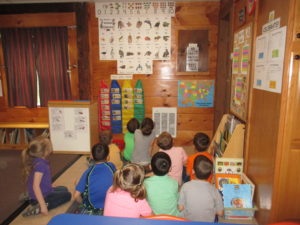
Jackson: We had bananas and crackers and apple juice and water. We learned about mammals on the Animal Alphabet. Mammals have hair or fur and they make milk for their babies. We found even and odd numbers. (By counting the numbers of mammals, birds, reptiles, and insects in the Animal Alphabet.)
Alba: I wrote LAFNT in my Journal. It’s called Kid Spelling. I drew a picture of an elephant in my Journal. I did a Tweet.